
Starlink’s global network has made it practical to bring reliable internet to places that were previously too remote, too temporary, or too expensive to serve with traditional infrastructure. It’s now deployed across retail chains, maritime fleets, construction sites, emergency response operations, and distributed enterprise environments.
Getting connected, though, is only one part of the solution.
As deployments grow, the challenge shifts from access to operations. Teams need to understand who is using bandwidth and how much. They need to control access across different groups, allocate costs, manage plans, and make sure usage aligns with business priorities. In many cases, this is happening across dozens or hundreds of locations, often with different stakeholders involved.

Kognitive Networks created Orbit to help enterprises and Starlink resellers deploy and manage Starlink at scale.
Kognitive is not a Starlink reseller – it’s a technology partner whose Orbit platform gives resellers and enterprises the operational control to run Starlink as a true managed service. Orbit is a connectivity commerce platform with complete subscription management:
- Custom plan catalog creation
- Pooled data allotment, reporting, and analytics
- Service automation – stop and start service automatically based on usage quotas
- Role Based Access Controls (RBAC) for end user self-service
- Integrated billing for groups or individual service lines
OrbitPlans is the core subscription management platform, and the optional OrbitBills adds integrated billing.
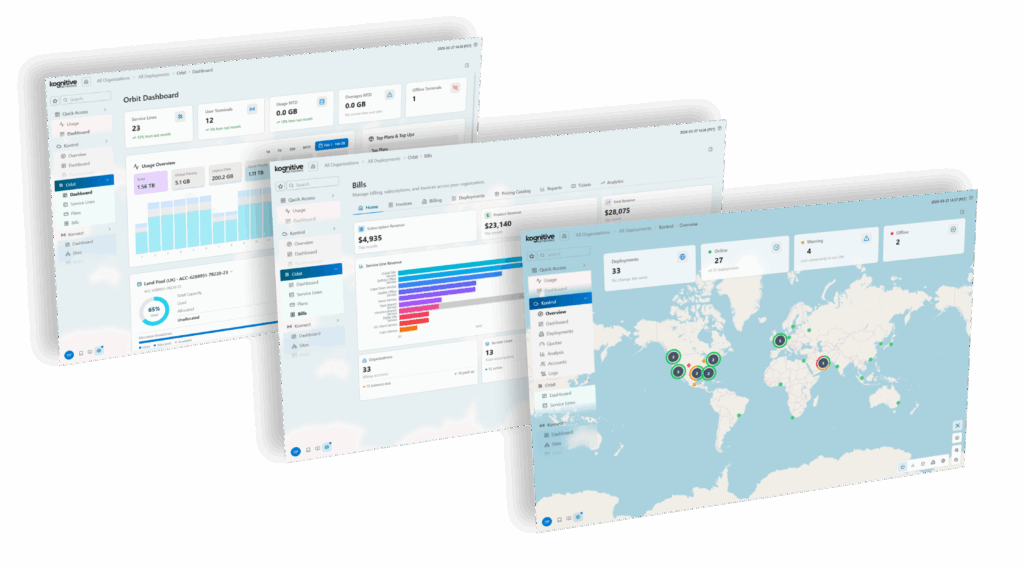
Orbit Scales With Your Deployments
The more Starlink grows in your organization, the more structure you need around it. Common deployments Orbit is built for:
- A retail chain where regional managers need visibility into their own locations while a central team oversees the full network
- A maritime operator where each vessel manages its own usage without losing fleet-level control
- A service provider responsible for multiple customers, each with different plans and expectations
Orbit brings structure to these deployments through native multi-tenancy — organizing deployments into logical groups, assigning access based on roles, and managing everything from a single system.

Multi-Tenancy Reflects How Businesses Work
Orbit lets teams create distinct environments for customers, business units, or projects — each with its own users, permissions, plans, and reporting, all within a single system. In practice, this means:
- A partner can deliver a customized branded experience – complete with logos, a branded documentation, and aligned domain for the application and user notifications
- A service provider can ensure each customer has their own usage dashboard, without building separate tools
- An enterprise can isolate regions or departments, and create optimized views for roles that align with specific workflows
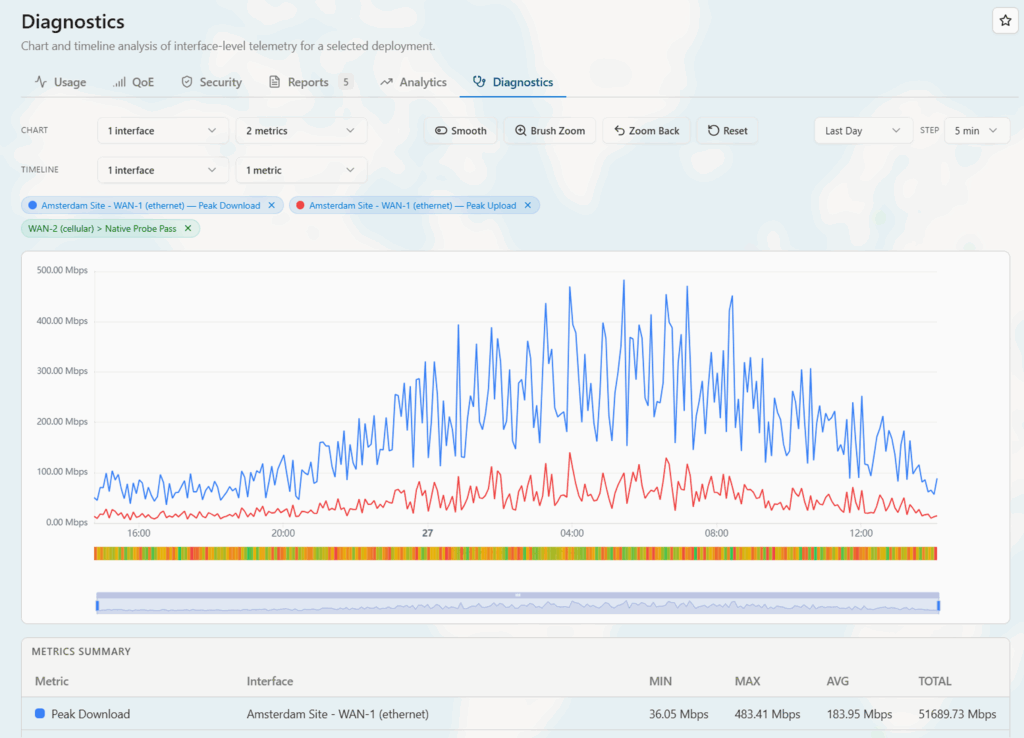
Managing Usage Instead of Chasing It
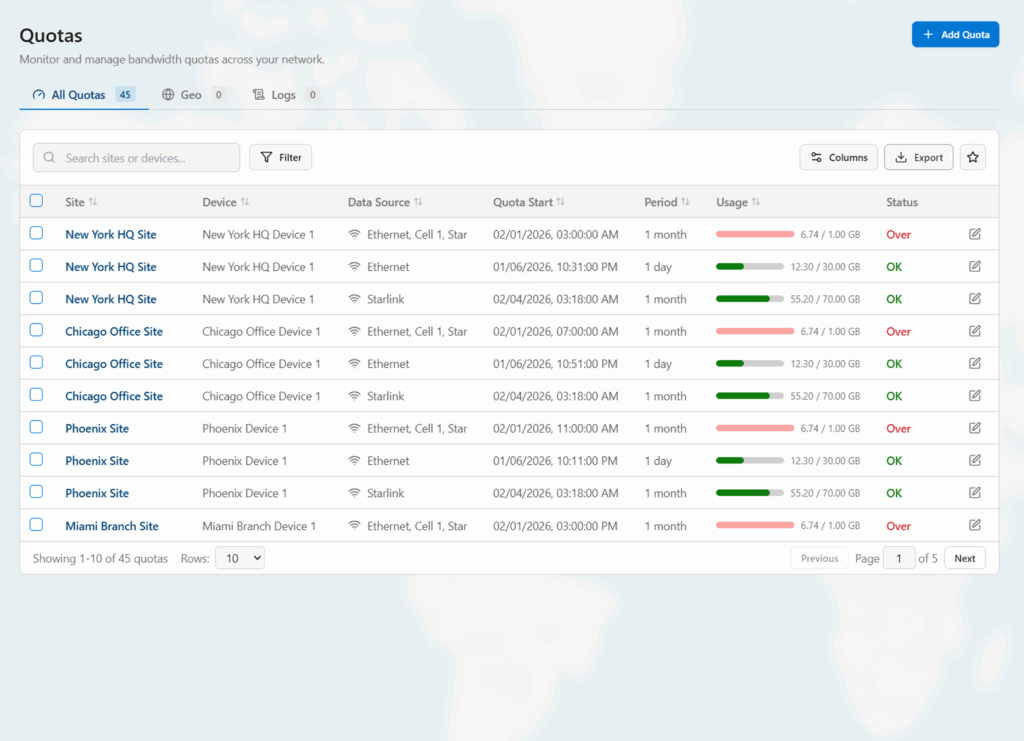
Most tools monitor usage but provide no clear way to act on it. Orbit connects usage data to policy and automation. With Orbit Plans:
- Define custom plans and pooled data models
- Set quota limits and send threshold alerts
- Pause data plans based on usage thresholds
- Extend access to end users, including self-serve data top ups and detailed analytics
In practice: a fleet can share data pools across terminals to reduce overall costs. A fleet operator is empowered by alerts and mobile app access that help monitor usage within a few minutes. A provider can offer structured plans without managing each terminal individually.

Simplifying the Business Side of Connectivity
As deployments grow, billing becomes one of the most time-consuming parts of the process — usage tied to plans, plans tied to customers, data exported and reconciled across entities.
Orbit Bills is an optional add-on package for billing automation that aligns usage, plans, and organizational structure from the start. Billing data reflects how the business actually operates, whether that means internal cost allocation or external invoicing. For service providers, say goodbye to spreadsheets and manual correlation of service line usage to individual customers at the end of the month. Orbit Bills integrates usage against plans, tracks top up purchases, and delivers a dynamic billing platform that can generate and send invoices asynchronously or on a monthly schedule. Full fiduciary functions such as tracking invoice status with payment history couple well with deep analytics to illuminate usage trends, growth, and churn.
Staying Aligned with Starlink API v2
Orbit now supports Starlink API v2, keeping teams aligned with Starlink’s current platform without requiring operational changes down the road. The new v2 features allow even more flexibility in multi-tenant access, as well as improvements in router management and new L2 routing options directly over Starlink’s network. As these features become more widely available, Kognitive customers will be able to access and apply them directly through Orbit.

Fixed IP and Network Control, Everywhere
Kognitive’s Konnect SD-WAN platform gives every Starlink site a fixed, routable IP via secure tunneling — one that stays consistent regardless of how the underlying connection shifts, or whether traffic moves across satellites, ground paths, 5G, or fiber.
For enterprise deployments, that consistency matters across the board:
- Remote access to field devices works reliably, without reconfiguration
- VPNs stay stable as the underlying connection moves
- IP-based security policies enforce as expected
- Troubleshooting is faster when every site has a predictable network identity
In mobile environments like maritime and in-vehicle deployments — where Starlink connections hand off more frequently — this is especially valuable. Konnect absorbs that variability so the rest of the network doesn’t have to.
A More Practical Approach to Distributed Connectivity
What organizations are ultimately dealing with is coordination — managing access across teams, allocating resources across locations, and maintaining visibility across a constantly changing environment.
Orbit brings that coordination into a single system. It doesn’t change how Starlink connects sites, but it changes how those connections are managed, understood, and integrated into the business.
See Orbit in Action
If you are managing Starlink across multiple locations, teams, or customers, you can schedule a demo to see how Orbit brings structure and control to those deployments.